
Learn how to build a manageable nonprofit training program by focusing on your mission, starting small, creating a plan, and tracking results.

Whether you have a formal training title or it’s just one of your many responsibilities, figuring out how to address every training need can feel overwhelming. You may be thinking about onboarding, customer service, specialized skills, and compliance. Where do you start?
Furthermore, how can you be sure your training is effective and getting the right results?
This article walks you through how to build one training program at a time so you can develop an effective training system without taking on too much at once.
Why Nonprofit Training Feels Hard to Manage
There’s a good chance you’re also facing challenges, like:
- Short staffing leading to burnout and retention problems
- Inconsistent or declining volunteer numbers
- Ever-changing technology
- A shrinking pool of funding
These broader issues also impact training. As a result, you might be dealing with:
- Little support or guidance. You might be a one-person training “team” without a formal background in instructional design or learning and development.
- A nonexistent budget. Competing priorities can make it difficult to justify investing in training when outcomes are not clearly defined.
- Tight schedules. Competing responsibilities can make it difficult for you to plan and deliver training, and for learners to complete it.
Additionally, the lack of a well-planned training system can lead to:
- Doing too much. HR Daily Advisory warns against “over-training” by placing too many demands on new employees, repeating the same training over and over, or sharing too many training resources without a clear direction. Any of these scenarios can lead to trainer burnout and learner disengagement.
- Going too fast. Reacting to problems (instead of anticipating them) might cause you to throw training content together quickly, without a clear plan. And this approach increases the risk of incomplete, irrelevant, or confusing training experiences, which can do more harm than good.
Finding time to plan, deliver, and complete training can be difficult for both trainers and learners. But the reality is, you can spend the time on training, or on addressing problems that pop up because training didn’t happen.
What Should an Effective Training Program Include?
First, let’s define exactly what a training program is. Small Business Trends describes it as “a structured approach to enhancing employee skills and knowledge, customized to meet specific organizational needs.”
It helps to think of a program as the roadmap for covering a main topic, such as onboarding or compliance. Each program is likely to include several components (various types of training content) that cover relevant subtopics. And as you build programs, you are growing a complete system to meet all your team’s or organization’s training needs.
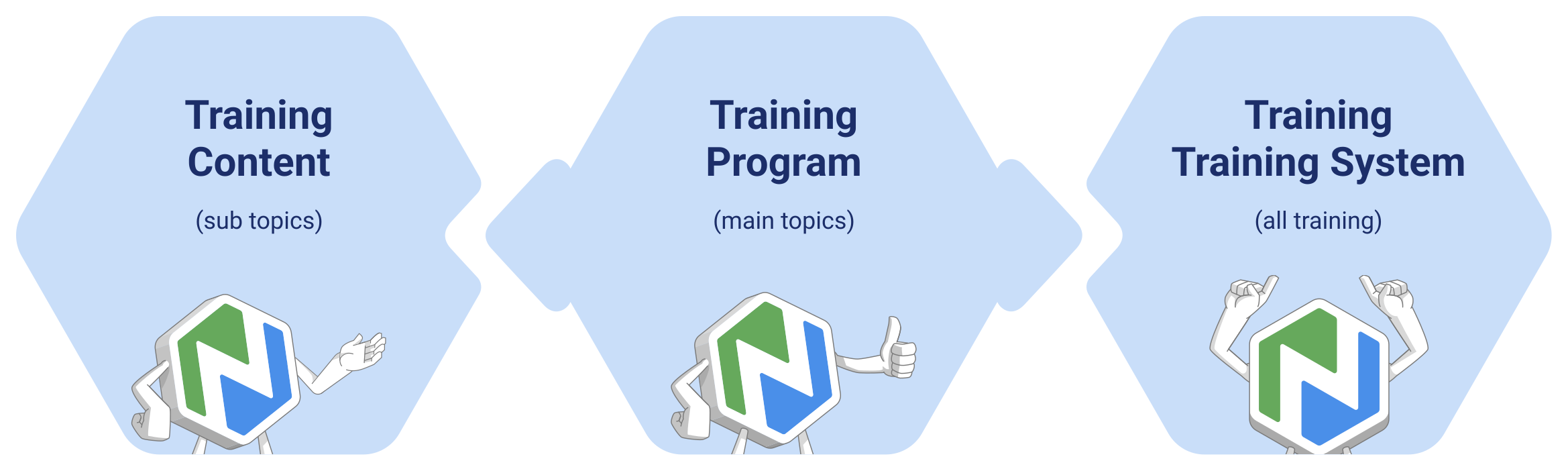 An effective training program usually includes:
- A clear main topic and target audience, such as orientation training for service desk staff, or management basics for supervisors.
- Well-defined outcomes that describe what learners should know and/or be able to do after completing the program.
- Helpful and relevant content that focuses on essential information.
- Appropriate delivery formats and duration, a mix of printed materials, online tutorials, and in-person meetings designed to provide training when it's needed most, without overwhelming learners or wasting their time.
- Ways to assess and evaluate progress so you can see how well learners understand and can apply what they’ve learned.
- Clear follow-up procedures that ensure the program runs smoothly and remains helpful.
How to Build a Training Program in Four Steps
Getting a training program up and running involves four main steps:
- Design. Identify the problem (main topic), define what you want the program to accomplish, plan the program, and choose, adapt, or create the training components. This is where you lay the groundwork for the remaining steps. The more detailed the plan, the more effective the program is likely to be.
- Deliver. Launch the training program. A well-written plan will have worked out exactly when and how the launch should occur, including which formats will best serve learners’ needs.
- Measure. Collect and review data. A well-written plan will also predetermine how you will measure training effectiveness.
- Iterate. Use training data to identify where learners need more support and to continue improving training over time.
If this is sounding like a lot to manage, the secret is to start small and take things one step at a time. Small steps will get you farther than not starting at all.
How to Start Small With One Training Program
We’ve created the Simple Training Program Workbook to help you plan one training program at a time.
It shows you how to:
- Choose one audience and one priority topic to focus on first
- Define a clear outcome for what people should know or do
- Decide what the program needs to cover without trying to cover everything
- Identify what content you can reuse, adapt, source, or need to create
- Outline the training components, delivery format, and rollout plan

Rather than repeat the full workbook here, let's drill down into some key steps.
Aligning With Your Mission
Focusing on your organization’s mission will help you prioritize training needs. According to The Training Blueprint newsletter, “A mission-driven needs assessment does not just highlight what’s missing, but clarifies what matters most, allowing training efforts to be focused, impactful, and fully aligned with the organization’s vision for success.”
Start by considering your organization’s overall goals. Then ask yourself, what do people need to learn or do to meet those goals?
In addition to providing clarity, this approach also helps you show learners the relationship between their training, their work, and your mission. In other words, they are better able to connect what they’re learning and doing with why it matters—and this awareness is likely to foster greater engagement with the training content.
Identifying Skill Gaps
Thinking about what people currently know and do, and what’s required to meet your organization’s goals, will reveal possible skill gaps. This analysis is important because you don’t want to waste anyone’s time on training for things they already know.
When you find a gap, it’s also important to consider contributing factors, like:
- Lack of resources
- Poor management
- Poor communication
This step will help you determine exactly what training is needed. For example, team members may understand the steps for following a policy but struggle to communicate. So, they don’t need more training on the policy itself, but need to learn how to communicate better.
Choosing a Training Topic
Your needs analysis is likely to turn up more than one training topic. Your organization probably has more than one goal, and you’ll probably identify more than one skill gap affecting more than one set of learners.
So, where should you start?
Use these criteria to prioritize topics:
- Mission fit - How clearly does the training outcome support your mission and goals?
- Urgency/risk - Is the outcome tied to an important deadline or could it prevent something really bad from happening?
- Reach/impact - How many people does the outcome affect, or how much impact could it have on your mission?
- Feasibility - Can you realistically deliver something useful in the next 60-90 days?
- Effort/Cost - What is the effort or cost?
Score each topic based on the criteria and a zero-to-three-point scale:
- 0 = Not at all
- 1 = Low
- 2 = Medium
- 3 = High
For effort and cost, a higher score should lower the overall priority because a high-effort program may not be the best place to start.
If you need help with the math, our free training prioritization spreadsheet can help you compare options.
You may still end up with a few top contenders, but this step should narrow the field. Then, you can use your best judgment to decide where to start. You might consider which audience needs training more urgently or which topic would be easier to cover first.
Choosing What to Measure
One of the first steps in planning a training program is to define a clear outcome—what you want the program to accomplish. The more clearly you describe the outcome, the easier it will be to measure the results.
Let’s say your topic is onboarding volunteers. A clear outcome might be something like, “By the end of this program, new volunteers will be able to explain their role, follow basic shift procedures, and identify when to involve staff.”
Then you can include components in the training program that enable you to collect data on the outcome. You might ask participants to describe their role in a quick reflection exercise, identify when to involve staff in a scenario-based knowledge check, and have experienced volunteers shadow newcomers during their first shift and report back.
The data from these components will show you how well the program is working, and whether it needs any changes or improvements.
Building a Manageable Program
Manageability is a big factor in getting a program started, and in keeping it going. This is why it’s better to start small and do what you can to the best of your ability. Again, a little progress is better than no progress.
So, how do you keep things manageable?
When you are developing the training, you can:
- Work with what you have. Instead of creating every piece of training content from scratch, look through your organization’s materials to find things you can reuse or adapt quickly.
- Find ready-made content. If your organization doesn’t have the required content, see if you can find it elsewhere, like Niche Academy’s Market.
- Keep things simple. If you have to create content, aim for simple text documents or quick videos captured with a mobile phone. Training content doesn’t have to be fancy to be effective.
And before you launch the program, you’ll want to think about:
- Who will answer questions or provide support?
- Who will review progress, and when should they do it?
- Who will follow up if someone falls behind?
You’ll notice each of these questions begins with “who”. It’s important for someone to own each step. You might tap one person, or several, depending on what’s manageable for you and your team. The key is to plan ahead and assign clear roles so everyone knows what’s expected of them. Without some oversight, the program is likely to be forgotten.
Choosing a Platform
There are a lot of ways to share content and deliver training, but a good learning management system (LMS) makes everything easier.
Here are a few things to consider when choosing an LMS:
- Look for a platform that has features you will use—without too many extras. A large, complicated LMS may be more than you need.
- Instead of a generic LMS intended for all types of organizations, consider one developed specifically for your industry that is more likely to have relevant features.
- The ideal platform lets you create, organize, deliver, and track training all in one place. It should help you:
How to Keep Your Training Program Going
We already talked about building a manageable training program. If you plan how to keep programs manageable from the start, they are more likely to be successful and sustainable. With this in mind, let’s look at how you can ensure things continue to go well.
Use Time Blocking
Stanford’s Center for Teaching and Learning describes time blocking as a method that “helps you stay intentional about how you’re spending your time.” They offer a step-by-step downloadable guide on creating a weekly calendar.
If you already have a full schedule, it’s easier to carve out small blocks of time instead of trying to do a lot at once. As long as you’re consistent, those small moments add up and will get you further than waiting for the “right” time.
Time blocking is useful for trainers and learners. You can use it to plan and implement training, and you can encourage learners to set aside 15-minute blocks to complete training.
Pull In Outside Support
Even if you are essentially a one-person training department, you don’t have to do everything on your own. You can consult with subject experts, bring in facilitators, or even set up a train-the-trainer program to spread the workload across your organization.
It also helps to connect with people doing training at other organizations like yours. You might be able to share ideas and resources.
Prioritize Adult Learning Principles
Consider the needs of adult learners as you source and develop training content. People are more likely to complete training and retain information when you:
- Connect learning to real situations. Use examples, scenarios, and low-stakes practice that reflect what learners may encounter in their work. Allowing learners to fail in a safe environment helps them build skills and confidence.
- Keep content focused and concise. Instructional designer and author, Cathy Moore, advises trainers to limit content to essential information because people can only store five to nine chunks of information in their working memory at a time.
- Respect learners’ time by letting them skip content they already know.
Take an Iterative Approach
Mapping out a clear program plan is a great start, but you won’t really know how well it will work until you implement it. Fully anticipating learners’ needs is next to impossible, and unexpected issues are likely to pop up. So, it’s best to start with the bare essentials, the smallest useful version of the program, and go from there. Then you can collect data and feedback and make improvements. This ongoing approach will save you time in the short term and lead to more effective training in the long term.
Keep Track of Data
The overall success of the iterative training development process depends on how well you track and use data. First, you need to choose the right metrics to see whether objectives were met. Then, you need to interpret the results and act on them. The data will tell you where more support or changes are needed.
Build Your Training System One Program at a Time
Building a training system does not mean creating everything at once. It means starting with one useful program, learning from it, and improving over time.
Choose one priority. Define the outcome. Build the smallest useful version. Measure results. Use what you learn to improve the program. Then repeat these steps for other training topics.
That’s how training becomes manageable. And over time, that’s how one program becomes a system your staff, volunteers, board members, and community members can rely on.
Need help planning your first program? Download the Simple Training Program Workbook to choose a priority topic, define your outcome, outline your content, and create a manageable rollout plan.


.png)

.png)

.png)
.png)

.png)

.png)